
3D Printing and Additive Manufacturing: Key Differences
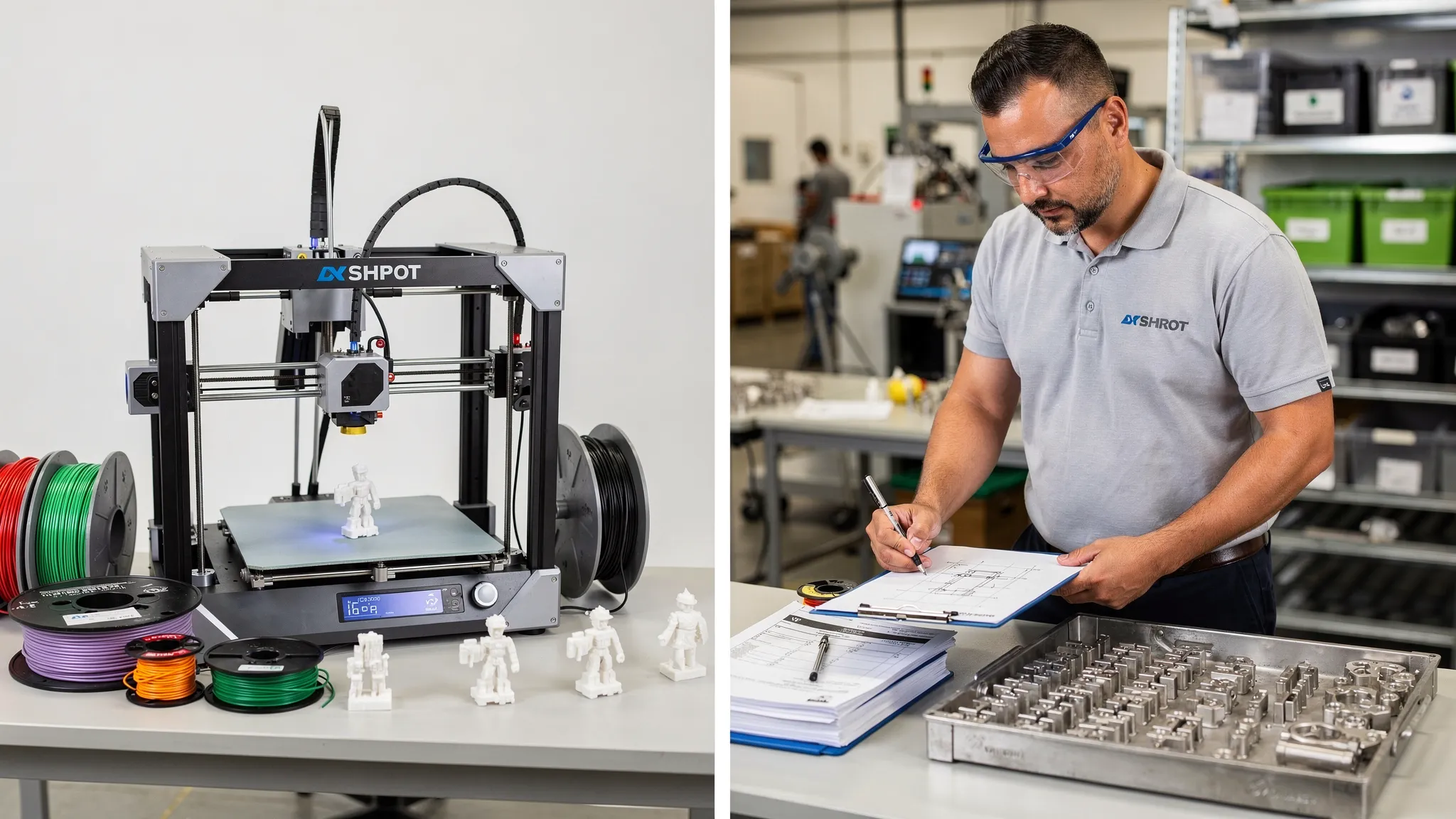
The terms 3D printing and additive manufacturing are often used interchangeably, and in many casual conversations that is perfectly fine. Both describe making physical objects from digital files by building material layer by layer instead of cutting material away from a larger block.
But the two terms do not always mean the same thing in practice.
For a hobbyist, designer, small business, or product founder, understanding the difference helps you ask better questions, choose the right service, and set realistic expectations for cost, finish, strength, and repeatability. The simplest version is this: 3D printing usually describes the process of making a part, while additive manufacturing describes a broader production approach built around that process.
The short answer: process vs production system
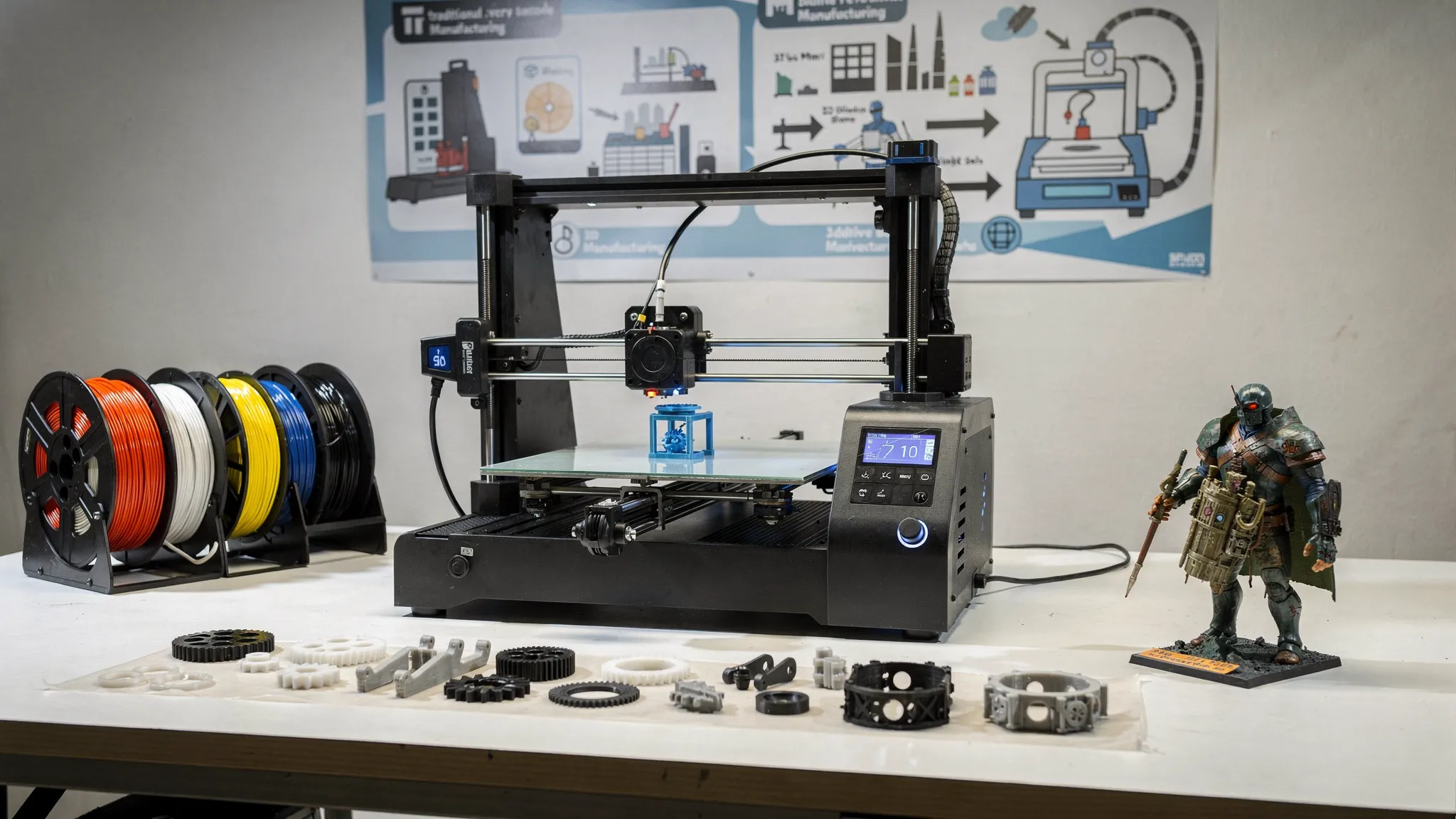
3D printing is the more familiar term. It is what most people say when they want a custom model, prototype, miniature, replacement piece, enclosure, desk accessory, or designer-authorized collectible made from a digital file. It focuses on the act of printing the object.
Additive manufacturing is the broader, more formal term used in engineering, product development, and production environments. It includes the printing process, but also covers design rules, material selection, part validation, quality control, documentation, repeatability, and how printed parts fit into a larger manufacturing workflow.
The ISO/ASTM 52900 terminology standard defines additive manufacturing as a process of joining materials to make parts from 3D model data, usually layer upon layer. That definition overlaps heavily with what most people call 3D printing, which is why the terms are so closely connected.
The difference is mostly about scope, intent, and level of control.
Key differences between 3D printing and additive manufacturing
Here is the easiest way to compare the two terms:
| Category | 3D printing | Additive manufacturing |
|---|---|---|
| Main meaning | Making a physical object from a digital 3D file | A complete manufacturing method built around layer-by-layer production |
| Common context | Hobby prints, custom orders, prototypes, miniatures, gifts, replacement parts | Engineering, production, tooling, regulated parts, repeatable business workflows |
| Focus | The print itself | The full lifecycle from design to finished, inspected part |
| Typical users | Makers, designers, consumers, small businesses, artists | Manufacturers, engineers, product teams, industrial buyers |
| Documentation | Often simple file and material notes | More likely to include specs, tolerances, revision control, inspection, and process records |
| Quantity | Often one-off or small batches | Can include prototypes, bridge production, low-volume production, and specialized end-use parts |
| Quality expectations | Good appearance and functional fit for the use case | Repeatable performance, traceability, and controlled production outcomes |
In other words, all additive manufacturing can be described as 3D printing in a broad sense, but not every 3D print order is treated like a manufacturing program.
Where 3D printing fits best
3D printing is the term most people use when the goal is straightforward: turn a design into a physical object. That object might be decorative, functional, experimental, or personalized.
Common examples include custom figures, terrain pieces, product mockups, brackets, organizers, cosplay components, desk accessories, replacement caps, display models, and small hardware-adjacent parts. A customer may already have an STL or 3MF file, or they may need help deciding whether a model is printable.
This is where a custom 3D printing service can be especially useful. Instead of buying a printer, tuning slicer settings, troubleshooting failed prints, and testing materials yourself, you can focus on the idea and let a print provider handle the production details.
For example, Firecloud Printz offers custom 3D printing, ready-made designer products, multiple material options, quick order estimates, and high-detail prints for customers who want a reliable finished result without managing every technical step themselves.
If you are still learning the workflow from file to finished part, Firecloud Printz has a plain-English guide to the 3D printing process step by step.
Where additive manufacturing fits best
Additive manufacturing becomes the better term when the printed part is part of a larger business, engineering, or production decision.
For example, a company might use additive manufacturing to create a low-volume batch of custom parts, test several design revisions before tooling, make jigs and fixtures for assembly, produce sales models, or build bridge parts while waiting for injection molding or machining. In these cases, the print is not just a one-time object. It is part of a controlled process.
That usually means more attention to details such as:
- Tolerance requirements
- Material behavior under load, heat, sunlight, or chemicals
- Surface finish expectations
- Batch consistency
- Revision history
- Inspection requirements
- Packaging and handling
- Whether the part is a prototype, tool, display piece, or end-use component
This is why manufacturers often say “additive manufacturing” instead of “3D printing.” The term signals that the work is being evaluated as a manufacturing method, not just a print job.
For a deeper business-focused view, see Firecloud Printz’s guide to what businesses use additive manufacturing 3D printing for.
The technologies overlap
The machines and materials can overlap heavily between 3D printing and additive manufacturing. The terminology does not always tell you which machine will be used.
A hobbyist and a professional shop may both use FDM printing. A small business and an industrial lab may both use resin printing. A manufacturer may use powder-bed fusion, binder jetting, or metal additive manufacturing for specialized applications.
The main difference is not the machine alone. It is how the machine is used, controlled, documented, and integrated into the project.
| Process type | Often called 3D printing when used for | Often called additive manufacturing when used for |
|---|---|---|
| FDM or FFF filament printing | Prototypes, organizers, brackets, hobby parts, fixtures | Low-volume functional parts, production aids, repeatable tooling |
| Resin printing | Miniatures, display models, high-detail parts | Dental models, master patterns, detailed engineering prototypes |
| Powder-bed polymer printing | Durable custom components, complex shapes | End-use polymer parts, batch production, lightweight assemblies |
| Metal additive processes | Less common in consumer use | Aerospace, medical, industrial tooling, high-performance components |
For most customers, the practical question is not “Which term is more correct?” It is “Which process, material, and finish match what this part needs to do?”
Why the distinction matters when ordering a part
The words you use can shape the conversation with a print provider.
If you ask for a 3D print, the provider may assume you need a physical object made from a file, with normal guidance around material, scale, detail, and finish. That is often enough for decorative prints, prototypes, personal projects, and one-off custom items.
If you describe the project as additive manufacturing, the provider may expect more production-oriented requirements. You may need to clarify tolerances, repeat orders, inspection criteria, strength expectations, and whether the part must match an engineering drawing.
A good order request does not need to sound technical. It just needs to explain the job clearly. Share what the part is for, how it will be used, where it will live, what dimensions matter most, and whether appearance or strength matters more.
If you are choosing between shops for a custom order, this guide on picking the right 3D print store can help you compare process fit, communication, materials, and quality signals.
A simple way to decide which term to use
Use “3D printing” when you are talking about a custom print, visual model, gift, collectible, prototype, or small functional object. It is clear, familiar, and accurate for most everyday projects.
Use “additive manufacturing” when you are talking about manufacturing strategy, production planning, repeatability, technical documentation, or business use cases. It is especially helpful when comparing printing with CNC machining, injection molding, casting, or other manufacturing methods.
Here is a quick reference:
| Your situation | Better term to use |
|---|---|
| “I want this model printed for my shelf.” | 3D printing |
| “I need a custom prototype to test fit and appearance.” | 3D printing or additive manufacturing |
| “I need 25 repeatable brackets for a product test.” | Additive manufacturing |
| “I want to browse ready-made designer prints.” | 3D printing |
| “We are comparing printing vs injection molding for a low-volume run.” | Additive manufacturing |
| “I need a high-detail miniature or display piece.” | 3D printing |
| “We need a documented workflow for ongoing part production.” | Additive manufacturing |
There is no penalty for using the “wrong” term. A good printing partner will help translate your goal into the right process.
Digital design is the common foundation
Both 3D printing and additive manufacturing start with digital design. A printable file needs real geometry, appropriate wall thickness, sensible tolerances, and features that match the intended printing process.
This is where physical product development often overlaps with software and app development. A startup might prototype a device enclosure with 3D printing while also building the mobile experience that controls or supports the product. In that case, working with an experienced mobile app development agency can complement the physical prototyping work by helping turn the digital side of the idea into a polished iOS or Android product.
For the printed object itself, the better your file and requirements are, the better your result is likely to be. Clean design choices reduce failed prints, improve surface quality, and make it easier to choose the right material.
Cost, speed, and sustainability considerations
One reason 3D printing became popular is speed. You can often move from file to physical part much faster than with traditional tooling. That is valuable for prototypes, small batches, and personalized objects.
Additive manufacturing can also reduce material waste in the right applications because parts are built up rather than carved out of a larger block. However, it is not automatically waste-free. Supports, failed prints, test pieces, material selection, and shipping all affect the real footprint of a project.
The most sustainable print is often the one that works the first time. That means choosing the right material, confirming the model is printable, avoiding unnecessary overbuilding, and using a process that fits the part’s purpose. Firecloud Printz emphasizes detailed printing and efficient custom production, which can help reduce guesswork for customers who do not want to troubleshoot prints themselves.
What to send when requesting a print or estimate
Whether you call it 3D printing or additive manufacturing, a clear request saves time. When possible, include the 3D file, dimensions, intended use, quantity, preferred material or finish, and any critical features.
If you do not know the right material, explain what the part must handle. For example, will it sit outdoors, flex slightly, hold weight, tolerate heat, or mainly look good on display? That information is often more useful than guessing a material name.
For decorative models, note the desired scale and level of detail. For functional parts, note holes, mating surfaces, threads, clips, and load-bearing areas. For repeat orders, include revision numbers so everyone knows which version is being printed.
So, are they actually different?
Yes, but the difference is practical rather than absolute.
3D printing is the everyday term for making objects from digital models. Additive manufacturing is the broader professional term for using layer-by-layer production as a manufacturing method. They share the same foundation, but additive manufacturing usually implies more planning, control, and repeatability.
If you are ordering a custom piece, browsing designer-authorized prints, or making a prototype, “3D printing” is probably the clearest term. If you are evaluating production, tooling, low-volume parts, or business workflows, “additive manufacturing” may better describe the project.
Frequently Asked Questions
Is 3D printing the same as additive manufacturing? They overlap, but they are not always used the same way. 3D printing usually refers to the act of making a part from a digital file, while additive manufacturing refers to the broader production method, including design, materials, process control, and quality expectations.
Which term should I use when requesting a custom part? Use 3D printing if you want a model, prototype, gift, replacement piece, or custom object printed. Use additive manufacturing if your project involves repeatable parts, production planning, technical requirements, or manufacturing comparisons.
Does additive manufacturing always mean industrial metal printing? No. Metal printing is one type of additive manufacturing, but the term can also include polymer filament, resin, powder-based plastics, and other layer-based processes. The context and requirements matter more than the material alone.
Is additive manufacturing better than traditional manufacturing? It depends on the part. Additive manufacturing is often excellent for complex geometry, customization, prototypes, and low-volume production. Traditional methods like injection molding or CNC machining may be better for very high volumes, certain materials, or extremely tight tolerances.
Can Firecloud Printz help if I am not sure what I need? Yes. If you have a digital design or an idea for a custom print, Firecloud Printz can help with custom 3D printing, material considerations, and quick order estimates. For ready-made items, you can also browse designer-authorized products in the shop.
Bring your digital design into the real world
Whether you call it 3D printing or additive manufacturing, the goal is the same: turn a strong idea into a physical object that looks, fits, and functions the way you need it to.
If you have a file ready, need help choosing a material, or want to explore custom printing options, visit Firecloud Printz to request an estimate or browse ready-made designer-authorized prints.
